
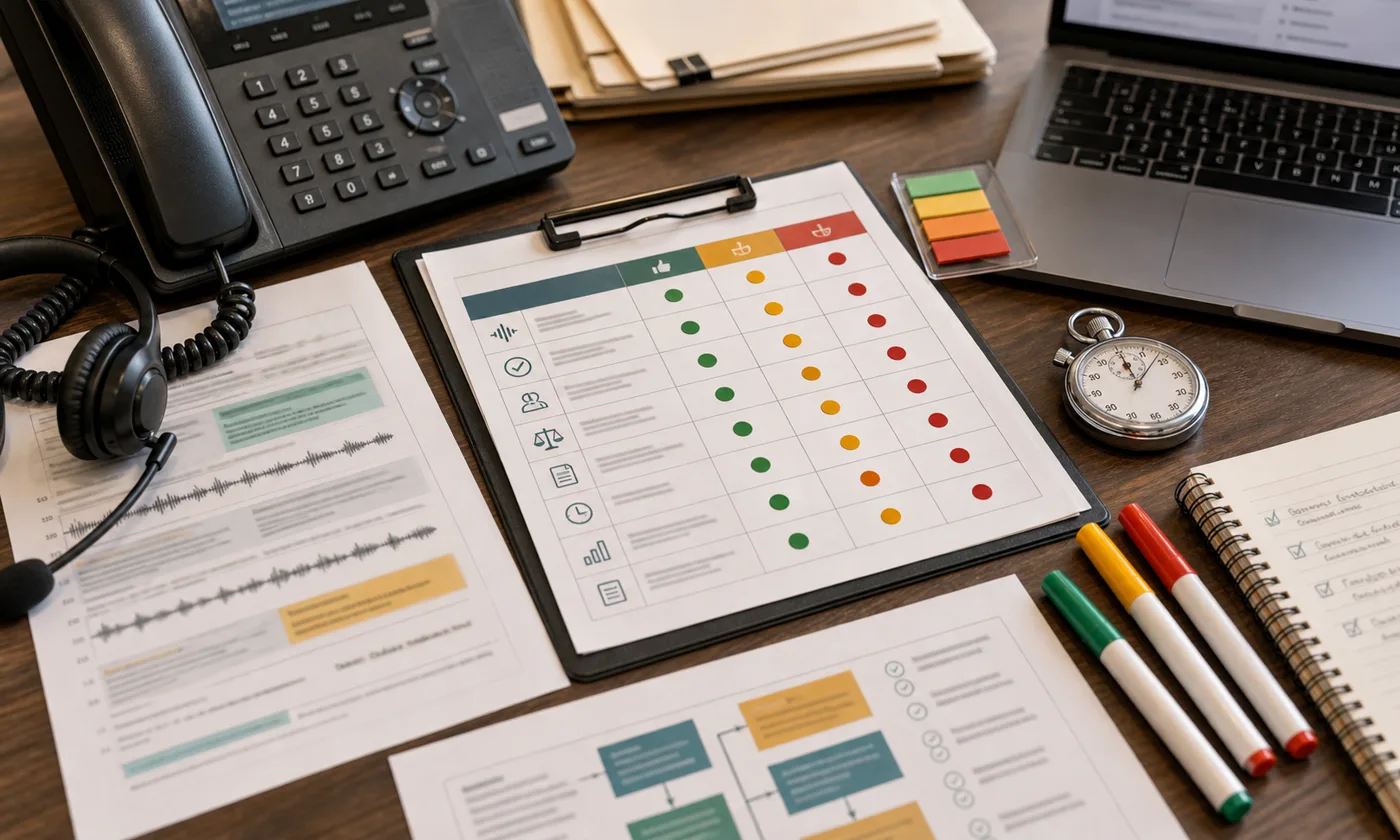
Why A Scorecard Matters
Most AI voice agent demos are optimized for the first minute. Buyers need to know what happens on the tenth awkward call, the first angry caller, the first bad integration response, and the first compliance review.
Use the same test workflow across every vendor. Do not compare one vendor’s polished booking demo against another vendor’s raw API sample.
Core Criteria And Weights
| Criterion | Weight | What a strong vendor shows |
|---|---|---|
| Latency and interruption handling | 15% | Natural turn-taking, short pauses, and safe barge-in recovery. |
| Workflow completion | 20% | The agent completes the business task, not just the conversation. |
| Integrations and tool calls | 15% | Calendar, CRM, ticketing, telephony, and webhook actions are observable and reliable. |
| Human handoff | 15% | Transfers include caller context, escalation reason, and fallback routing. |
| Compliance controls | 15% | Call recording, consent, data retention, opt-out, and regulated-workflow claims are clear. |
| Testing and analytics | 10% | Transcripts, recordings, summaries, failure reasons, and cost reporting are easy to review. |
| Total cost shape | 10% | Subscription, minutes, telephony, model, voice, setup, and support costs are understandable. |
Suggested Weighting
For SMB receptionists, weight ease of setup, call coverage, booking, and fallback highest. For developer platforms, weight orchestration, observability, tool calling, latency, and infrastructure control highest. For regulated buyers, compliance evidence and human escalation should outrank voice personality.
Evidence To Collect
Each score should be backed by an artifact:
| Score area | Evidence |
|---|---|
| Latency | Timestamped test calls across greeting, normal response, interruption, tool wait, and transfer. |
| Workflow completion | Screenshot, log, or record showing the appointment, lead, ticket, reservation, or summary was created correctly. |
| Integrations | Tool-call logs, webhook events, CRM notes, calendar entries, or ticket updates. |
| Handoff | Transfer packet, staff notification, call whisper, CRM task, or callback note. |
| Compliance controls | Data terms, recording controls, retention settings, BAA availability, opt-out behavior, or consent logs. |
| Analytics | Transcript, recording, structured fields, outcome evaluation, failed-call reason, and cost trace. |
| Cost | Written quote modeled at expected and peak volume. |
If there is no evidence, the score should be conservative. A confident verbal answer is not the same as a verified call.
Scoring Method
Score each criterion from 1 to 5:
| Score | Meaning |
|---|---|
| 1 | The vendor cannot show the capability or avoids the question. |
| 2 | The capability exists, but only through brittle workarounds or unclear support. |
| 3 | The capability works in common cases with normal buyer oversight. |
| 4 | The capability is configurable, observable, and tested across edge cases. |
| 5 | The capability is production mature and backed by evidence, controls, and clear ownership. |
Then multiply by the weight. Keep the raw notes. The score is less useful than the reason behind it.
Role-Specific Adjustments
Different teams should adjust the scorecard:
| Team | Increase weight for |
|---|---|
| Front desk or operations | Staff usability, summary quality, business-hours routing, and escalation clarity. |
| Engineering | API control, logging, versioning, tool schemas, and integration failure behavior. |
| Compliance or legal | Recording, retention, disclosure, consent, access control, and contract evidence. |
| Finance | Cost per completed workflow, overages, support costs, and peak-volume economics. |
| Sales or intake | Lead quality, speed to response, CRM handoff, and human transfer for high-value callers. |
The best decision memo should show both the weighted score and the reason a weight changed.
Red Flags
- The vendor cannot explain call recording and data retention
- Pricing excludes telephony, model, or voice costs
- The demo does not show caller interruptions
- Escalation is vague or manual-only
- Integrations rely on brittle Zapier-only workarounds for core workflow steps
- The vendor claims healthcare or legal readiness without contract-level details
- The agent completes a task in the demo but the vendor cannot explain failure handling
- The buyer cannot export transcripts, recordings, or call summaries for QA
How To Avoid Demo Bias
Do not score during the first live demo. Sales demos are optimized for smoothness. Score after the buyer has run a repeatable test pack, reviewed evidence, and checked pricing.
Use these rules:
- Same script for every vendor
- Same success event for every vendor
- Same failure case for every vendor
- Worst call reviewed before best call
- Staff reviewer included, not only executives
- Compliance questions answered in writing
- Cost modeled at expected and peak volume
This keeps the shortlist grounded in the operating reality after launch.
Minimum Test Pack
Run at least five calls before shortlisting: a normal success case, a caller correction, an interruption-heavy call, a low-confidence intent, and a handoff/escalation case. Save transcripts, timestamps, cost estimates, and failure notes for every vendor.
Buyer Output
At the end of evaluation, produce a one-page decision memo:
- Best fit by workflow
- Highest operational risk
- Required integrations
- Required compliance review
- Estimated monthly cost at expected call volume
- Staff handoff process
- Launch scope for the first 30 days
That memo prevents the team from choosing the most impressive demo instead of the safest deployment.
Buyer FAQs
What is the most important AI voice agent scorecard category?
Workflow completion is usually the anchor because the agent must finish the business task, not just sound natural. Regulated or high-trust workflows may weight compliance evidence and human handoff even higher.
Should demo voice quality dominate the score?
No. Voice quality matters, but it should not outweigh latency, interruption handling, tool calls, handoff context, compliance controls, analytics, and cost per completed workflow.