
Short Definition
An AI voice agent is software that can hold a spoken conversation over the phone, understand caller intent, respond in natural language, and take actions in connected systems.
That last part matters. A basic voice bot may answer a question. A useful business voice agent can qualify a lead, book an appointment, route a call, create a ticket, or send a summary into a CRM.
The phrase covers several product types. Some tools are finished AI receptionists for small businesses. Some are developer platforms for building custom phone agents. Some are vertical products for restaurants, law firms, clinics, or contact centers. They share the same core idea, but they require different levels of setup, testing, and operational ownership.
How It Differs From IVR
Traditional IVR systems force callers into menus. AI voice agents let callers speak naturally. Instead of “press 1 for sales,” a caller can say, “I need to reschedule my appointment,” and the agent can ask a follow-up question.
IVR is usually menu-first. AI voice agents are intent-first. That does not mean AI is always better. A short IVR can be safer than a poorly designed voice agent if the call is simple and predictable. AI becomes more useful when the caller path needs natural language, follow-up questions, routing, summary, or a connected action.
What Makes It Different From A Chatbot
Phone conversations are harder than text chat. The agent has to handle interruptions, background noise, accents, phone routing, caller emotion, and the pressure of real-time response. A chatbot can pause while it thinks. A phone agent has to manage silence gracefully.
The best systems combine:
- Speech recognition
- Conversation policy
- Tool execution
- Natural-sounding voice output
- Call transfer
- Transcript and recording review
- Analytics and monitoring
What Happens During A Call
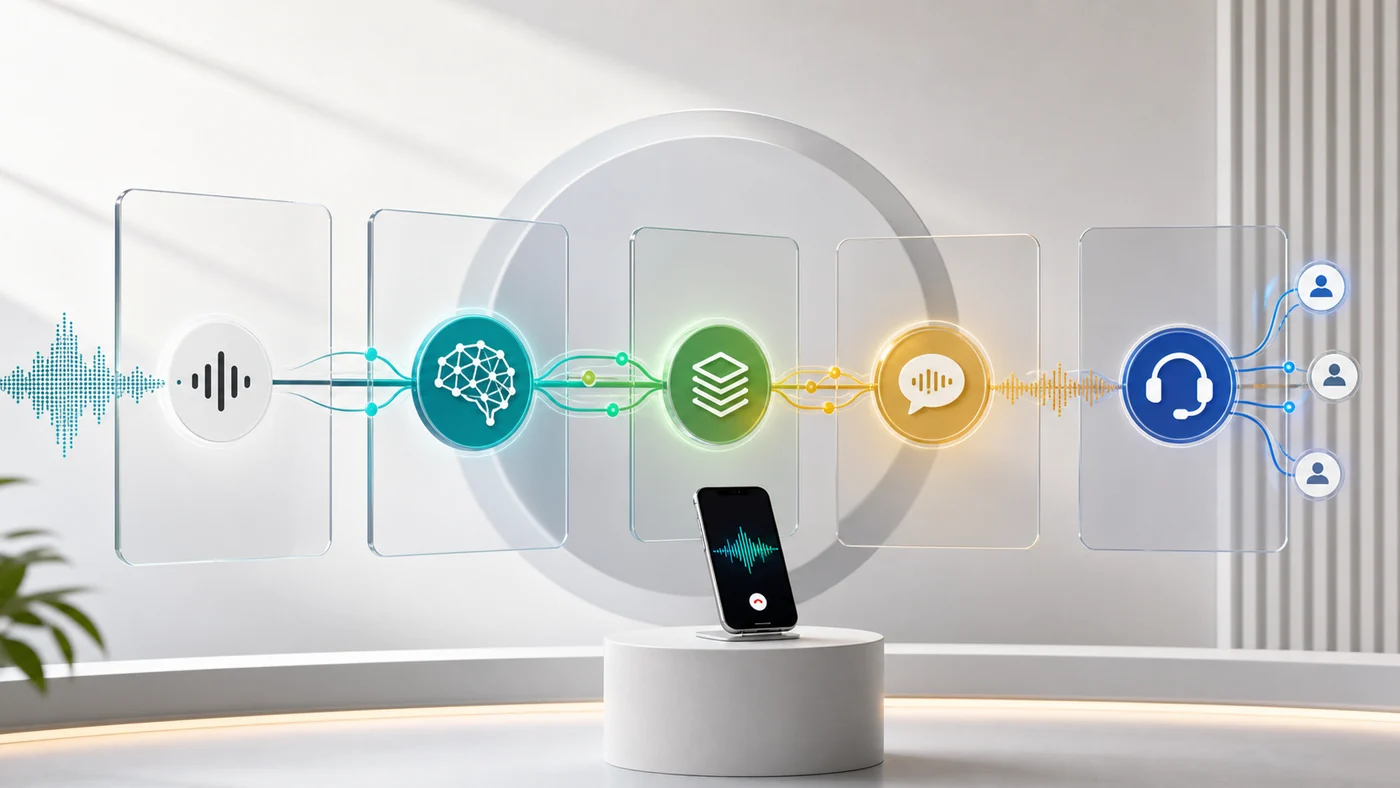
A business call usually follows this path:
- The caller reaches a phone number, forwarding rule, SIP trunk, or voice platform.
- The agent greets the caller and detects the first intent.
- Speech recognition turns audio into text.
- The conversation layer decides what to ask, answer, or do next.
- The agent may call a tool such as a calendar, CRM, ticketing system, reservation platform, or webhook.
- Text-to-speech creates the spoken response.
- The agent completes, transfers, takes a message, or schedules a callback.
- The system produces a transcript, summary, structured fields, analytics, and any downstream updates.
The caller only hears a conversation. The business needs to inspect the whole path.
Common Business Uses
- Answer missed calls
- Qualify leads
- Book appointments
- Route urgent issues
- Answer FAQs
- Create support tickets
- Send post-call summaries
- Follow up with consented leads
Common Product Types
| Type | Best fit | What to inspect |
|---|---|---|
| AI receptionist | Small businesses, clinics, salons, home services, local offices | Setup speed, hours, knowledge updates, staff dashboard, booking, message quality. |
| Developer platform | Product teams, agencies, engineering-led operators | APIs, tools, webhooks, logs, telephony, call analysis, deployment controls. |
| Hybrid AI and human service | Law firms and high-trust service businesses | Human backup, intake quality, transfer context, plan limits, CRM handoff. |
| Vertical voice AI | Restaurants, dental, hospitality, real estate, field service | Industry integrations, specialized scripts, staff review, policy updates. |
| Enterprise contact-center AI | Support, sales, BPO, larger operations | Routing, QA, analytics, security, role controls, volume handling. |
Where AI Voice Agents Fit
| Workflow | Good fit | Risk to watch |
|---|---|---|
| After-hours answering | Capture messages, answer FAQs, route urgent calls | Overpromising callback timing |
| Appointment booking | Ask intake questions and reserve slots | Calendar errors and caller corrections |
| Lead qualification | Capture budget, location, need, and urgency | Consent and bad qualification logic |
| Support triage | Create ticket and route by issue type | Sensitive or angry callers trapped in automation |
| Restaurant calls | Hours, reservations, wait times, menu questions | Order complexity and guest complaints |
What AI Voice Agents Should Not Do By Default
Most businesses should avoid launching with the hardest calls first. AI voice agents should not make medical, legal, or financial judgments without approved policies and human escalation. They should not invent prices, appointment availability, menu policy, eligibility, or guarantees. They should not keep a caller trapped after the caller asks for a person. They should not run outbound campaigns unless consent, opt-out, retry policy, and suppression handling are documented.
Good automation has boundaries. The best first workflow is usually narrow: missed-call recovery, after-hours capture, appointment intake, reservation handling, support triage, or lead qualification.
Buyer Warning
Do not evaluate AI voice agents only by demo voice quality. Buyers should inspect latency, interruption handling, fallback behavior, integrations, compliance settings, and whether the agent completes the intended task.
Quick Qualification Test
Ask a vendor to explain one real workflow from phone ring to final system update. If the answer skips call routing, tool failures, handoff, analytics, or pricing, the product may be less mature than the demo sounds.
Simple Buyer Test
Ask the same vendor to run this scenario:
A caller wants to book an appointment, changes the preferred date, asks a pricing question the agent should not guess at, then asks to speak with a person.
That one scenario tests caller correction, knowledge boundaries, tool use, and handoff. A good result is not just smooth speech. A good result is accurate capture, safe language, a clear next step, and a useful summary for staff.
Buyer FAQs
How is an AI voice agent different from an IVR?
An IVR is menu-first and usually asks callers to press numbers. An AI voice agent is intent-first, lets callers speak naturally, and can take actions such as booking, routing, ticket creation, or CRM updates.
What should an AI voice agent not do by default?
It should not give medical, legal, or financial advice, invent policy, promise outcomes, trap callers who ask for a person, or modify important systems without clear workflow rules and review.