
Short Answer
Bland AI and Synthflow both fit buyers who want AI phone automation without building from a raw telephony API. Start with Bland AI when workflow control, scale, outbound governance, and technical ownership matter. Start with Synthflow when no-code setup, operations ownership, integrations, analytics, and staff repair workflow matter more than deeper platform control.
Operating Difference
Bland AI and Synthflow both belong on shortlists for buyers who want voice automation without starting from a raw telephony API. The difference is operating fit.
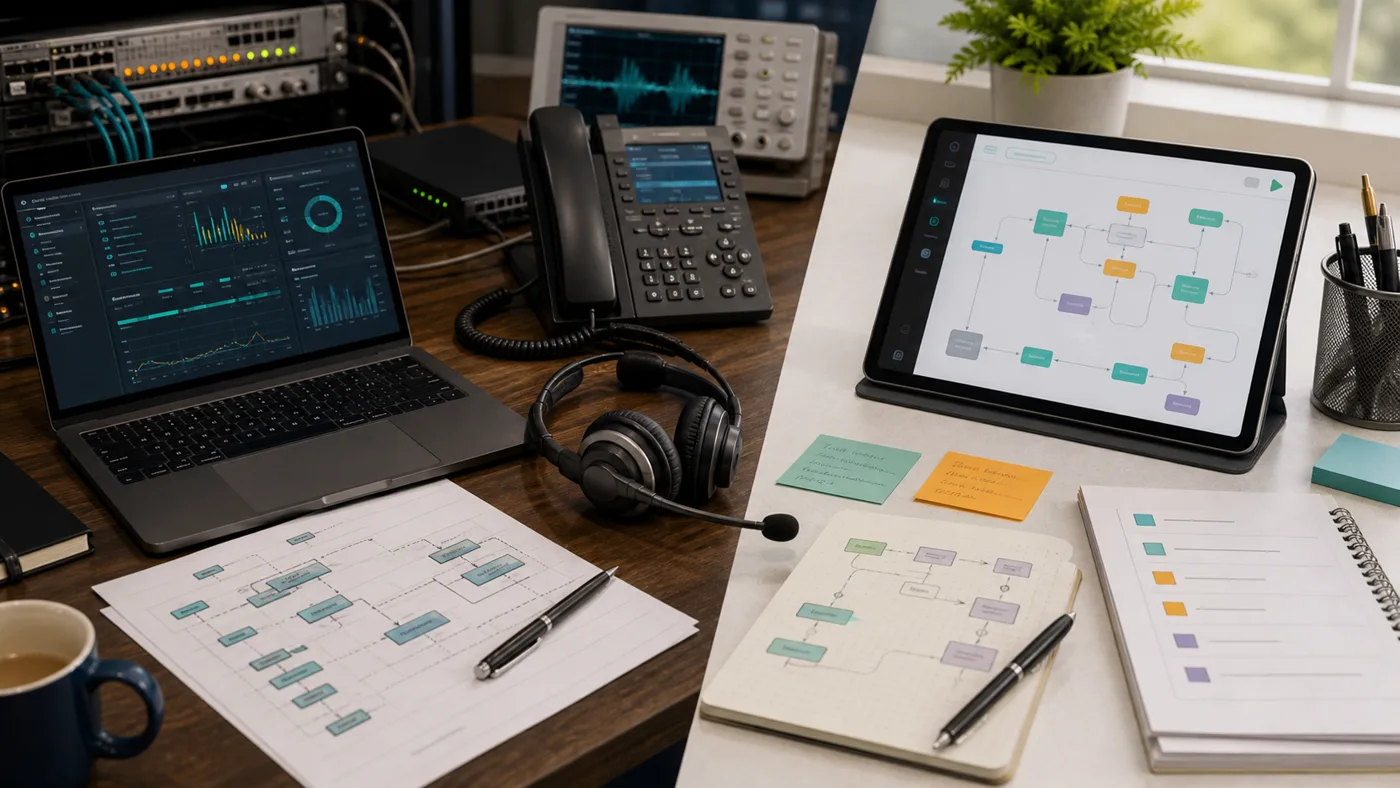
Bland AI is usually the stronger first look when the buyer wants enterprise-oriented voice automation, deeper workflow control, and more direct ownership of call behavior. Synthflow is usually the stronger first look when the buyer wants no-code or operations-led deployment, practical integrations, testing, analytics, and a lower-friction path for non-developers.
The right choice depends on who will build, monitor, and repair the calls after launch. If the owner is technical, Bland AI may feel more natural. If the owner is an operations manager, Synthflow may be easier to govern.
Best Fit Summary
| Buyer situation | Better starting assumption | Why |
|---|---|---|
| Enterprise team with technical resources | Start with Bland AI | Workflow depth, scale, and deployment control may matter more. |
| Operations team without engineers | Start with Synthflow | No-code setup and business-facing launch workflow may be more practical. |
| Agency building repeatable voice agents | Test both | Bland may fit custom control; Synthflow may fit faster client delivery. |
| Contact-center pilot | Test both against routing and QA | Handoff, analytics, failure logs, and staff review decide fit. |
| Regulated workflow | Do not decide from demos | Contract terms, data handling, escalation, and security review are decisive. |
Bland AI vs Synthflow vs Nearby Alternatives
This comparison should not be isolated from the broader platform cluster. If the buyer is also evaluating developer control, use Vapi vs Synthflow and Retell AI vs Vapi. If the buyer wants a broader replacement list, use Vapi Alternatives and Retell AI Alternatives.
| Nearby option | When to include it |
|---|---|
| Vapi | The team wants API-first assistant, tools, phone, and analysis control. |
| Retell AI | The team wants production phone-agent workflows and platform operations. |
| Goodcall | The buyer wants packaged SMB receptionist coverage, not a flexible platform. |
| Telnyx | The phone, SIP, carrier, and media-stream layer is the real decision. |
What To Compare
| Layer | Bland AI buyer question | Synthflow buyer question |
|---|---|---|
| Workflow design | How deeply can pathways, call logic, and branching be controlled? | How quickly can a non-developer build, test, and launch the workflow? |
| Integrations | How are APIs, webhooks, CRM, and post-call actions connected and logged? | Which business integrations are native, and where do custom actions start? |
| Testing | Can the team simulate, evaluate, and review failed paths before launch? | Can operations teams test and improve calls without engineering tickets? |
| Handoff | Are warm transfers, escalation reasons, and fallback routes observable? | Can staff receive clean context and act on it quickly? |
| Analytics | Are logs, call outcomes, transcripts, and cost data exportable? | Are dashboards and reporting useful for non-technical managers? |
| Governance | Are security, access, retention, and enterprise controls clear enough? | Are roles, approvals, and support boundaries clear enough for rollout? |
Ownership Test
Run the same failed call through both platforms, then ask two people to diagnose it:
- A technical owner should inspect the workflow, tool call, log, transcript, and transfer behavior.
- An operations owner should identify what staff would change before the next call.
If only the technical owner can understand the problem, Synthflow’s operations pitch deserves a closer look. If the operations owner wants a capability the builder cannot expose, Bland AI deserves a closer look.
Buyer Test Plan
Use a workflow that reveals operational depth. Lead qualification works well:
- Caller asks a normal qualifying question.
- Caller changes details after the agent starts summarizing.
- Caller asks for a human.
- CRM or webhook action fails.
- Caller gives a sensitive or high-value request.
- Staff reviews the transcript, summary, transfer reason, and structured fields.
Run the same script across both platforms. If one vendor chooses a different demo, the comparison becomes useless.
Evidence To Request
| Evidence | Why it matters |
|---|---|
| Workflow map or pathway export | Shows how logic actually branches. |
| Test-call transcript | Shows caller correction, interruption, and summary accuracy. |
| Tool/webhook log | Shows whether actions are debuggable. |
| Transfer packet | Shows whether human teams receive useful context. |
| Failure taxonomy | Shows whether bad calls can be improved. |
| Analytics export | Shows whether operations can track outcomes over time. |
| Pricing model | Shows what happens at normal, peak, and failed-call volume. |
| Security and data terms | Shows whether procurement can approve the workflow. |
Pricing Comparison
Public pricing and packaging can change, so verify current terms from the vendor before procurement. Normalize the quote by:
- Base plan
- Included calls or minutes
- Overage
- Phone numbers and telephony
- Voices, model usage, and premium features
- Setup or implementation
- Integrations
- Analytics and export
- Human fallback or transfer costs
- Support level
Use the AI Receptionist Pricing Calculator for cost per completed workflow. For operations-led teams, completion quality and staff review time usually matter more than a low headline price.
Compliance And Data Review
Bland AI and Synthflow buyers should review:
- Recording disclosure
- Transcript retention
- Access controls
- Data export and deletion
- Subprocessors
- BAA or regulated-workflow support where applicable
- Outbound consent and opt-out if outbound is in scope
- Escalation rules for sensitive calls
Do not rely on a homepage claim. Ask for current contract documents and settings screenshots during procurement.
When Bland AI Is The Better First Test
Start with Bland AI when:
- Enterprise voice automation depth matters.
- The buyer wants more control over call pathways and deployment shape.
- High call volume, batch calling, or complex routing is likely.
- The team has technical resources or an implementation partner.
- Security and enterprise procurement are central to the buying process.
The buyer still needs proof that business teams can review, improve, and govern failed calls.
When Synthflow Is The Better First Test
Start with Synthflow when:
- Operations teams need to build without a raw API.
- The first workflow should launch quickly.
- Business integrations and deployment support are more important than infrastructure ownership.
- Managers need dashboards, analytics, and practical call improvement loops.
- The buyer wants a no-code platform path rather than a custom engineering project.
The buyer still needs proof that workflow logic, transfer, and failure handling are strong enough for production.
When Neither Is The Right Starting Point
Do not start with Bland AI or Synthflow if the buyer mainly needs a packaged receptionist for simple missed-call coverage. In that case, compare Goodcall, Rosie, Allo, Open.cx, Smith.ai, and Ruby through the Best AI Receptionist for Small Business guide.
Do not start with either platform if the buyer is building a real-time voice feature inside a product and wants framework-level control. In that case, compare Vapi, LiveKit, Pipecat, and Daily with the Vapi vs LiveKit vs Pipecat comparison.
Red Flags
Slow down if:
- The vendor cannot show a failed call record.
- Transfer works but staff receives no useful context.
- Call summaries are not reliable enough for action.
- Pricing is unclear at peak volume.
- The workflow requires custom engineering but the buyer has no owner.
- Regulated claims are not backed by current contract documents.
- Staff cannot update knowledge, hours, routing, or policies quickly.
Final Recommendation
Choose Bland AI when enterprise voice automation control and scale are the main requirements. Choose Synthflow when no-code deployment, business-team ownership, and operational workflow management are the main requirements.
For a serious purchase, test both with the same failed-call script before choosing.
Source Trail
- Bland AI documentation
- Synthflow documentation
- Related Voice Agent Index guides: Vapi vs Synthflow, Retell AI vs Vapi, Vapi Alternatives, Evaluation Scorecard, Human Handoff, and Observability
Comparison FAQs
Is Bland AI or Synthflow better for no-code teams?
Synthflow is often the better first look for teams prioritizing no-code setup and operational deployment. Bland AI is often the better first look for enterprise buyers that want deeper voice automation control, scale, pathways, and deployment options. Both should be tested against the same workflow.
Which platform is better for enterprise voice AI?
Enterprise buyers should compare Bland AI and Synthflow on security review, analytics, transfer behavior, workflow testing, integrations, role controls, support model, and current pricing. The better platform is the one the team can govern and improve after failed calls.
What should I test before choosing Bland AI or Synthflow?
Test a production-like workflow with caller correction, failed tool behavior, handoff to a human, transcript review, structured extraction, and cost at expected call volume.