

Direct answer: Google's Gemini Call for Me makes AI-to-business calling a buyer proof problem. Google's help page says Gemini can call businesses for routine tasks, disclose itself as Google's AI assistant on a recorded line, use the user's phone number, show a live transcript, let the user take over, and avoid emergency, financial, sensitive-personal-information and telemarketing calls. Businesses and voice-agent buyers should require a Business Intake Proof Packet before approving AI callers or AI reception workflows: disclosure script, task scope, approved data, transcript policy, takeover rule, opt-out handling, prohibited actions and closure log.
What happened
- TechCrunch reported September 24, 2026 that Google is testing Gemini Call for Me, a feature that lets Gemini call businesses for eligible U.S. Pixel 11 users with a Gemini subscription and the Phone by Google beta app.
- Google's Gemini help page says users can ask Gemini to call businesses for business hours, product availability, service quotes, appointments, reservations, phone menus and hold time.
- The help page says Gemini starts each call by disclosing that it is an AI assistant from Google calling on a recorded line on the user's behalf, and states the user's name.
- Google says users review the number and details Gemini will share before calling, can monitor the live transcript or audio, and can take over the call.
- The same help page says Gemini uses the user's mobile network and phone number, supports only U.S. phone numbers for now, and has daily limits.
- Google also says Gemini cannot make emergency calls, complete financial transactions, share sensitive personal information, or make telemarketing calls.
Why this is trending
- AI phone agents are moving from demos into ordinary business calls that reception desks, support teams and reservation lines may actually receive.
- The receiving business needs a policy for disclosed AI callers before staff improvise with appointments, quotes, stock checks or account questions.
- Live transcript and takeover features create a new evidence chain: what the AI said, what the human saw, when the human intervened and what outcome was recorded.
- Google's prohibited-action list gives buyers a useful baseline for what AI phone agents should not handle without stronger controls.
- The rollout follows recent OpenAI, Meta and research stories about voice agents acting across apps, payments, calls and real-world workflows, raising the buyer bar for proof.
The Voice Agent Index take
A voice-agent buyer should treat Gemini Call for Me as a signal that AI callers will reach normal business phone lines, not only controlled vendor demos. Ask whether your receptionist, call center, AI answering service or outsourced support team can identify an AI-disclosed caller, decide which requests are safe, refuse sensitive or payment actions, preserve the transcript, support human takeover, respect opt-outs and close the loop without creating duplicate bookings or unsupported promises. If that chain is not written down, the phone workflow is not ready.
Business Intake Proof Packet
A voice-agent buyer checklist for validating AI-caller disclosure, task scope, approved personal details, live transcript, human takeover, opt-out handling, prohibited actions and closure logs.
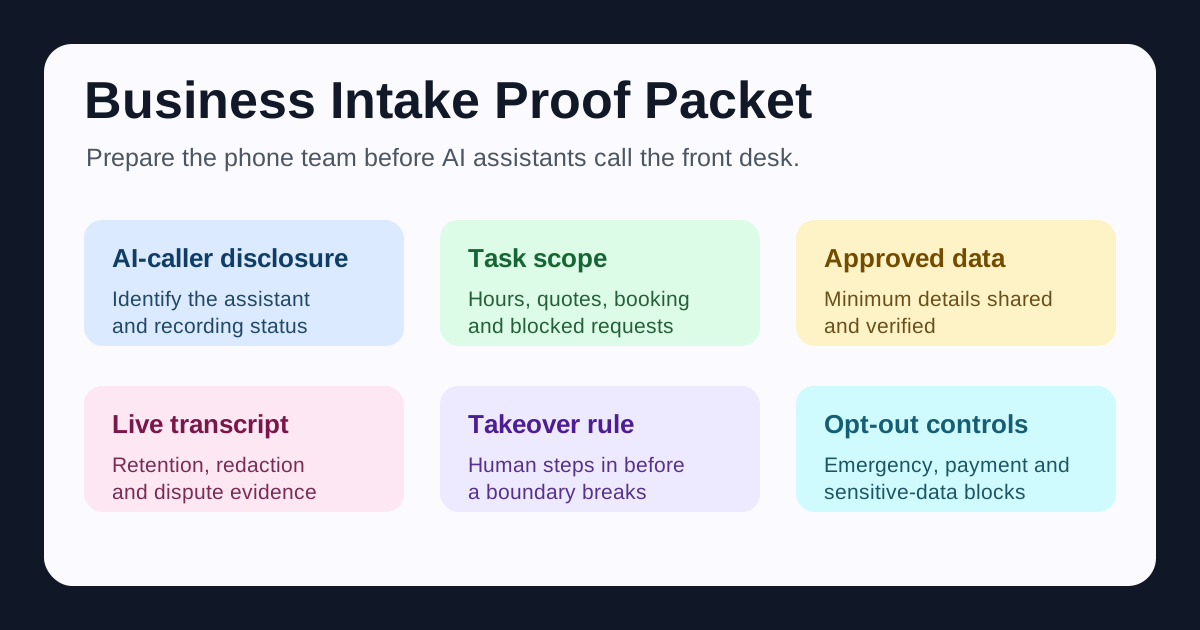
| Proof item | Why it matters | Buyer ask |
|---|---|---|
| AI-caller disclosure | Staff need to know when the caller is an AI assistant acting for a person, especially if the call is recorded or relays approved personal details. | Write the intake script for AI-disclosed callers, including how staff confirm caller authority, recording status and allowed request types. |
| Task scope | Routine requests such as hours, quotes, appointment changes and product holds can become account, payment or regulated tasks mid-call. | Classify which requests an AI caller can complete, which require human callback and which must be refused or escalated. |
| Approved data | Google's flow asks users to review details shared by Gemini; businesses need equivalent rules for what they may ask or reveal. | Limit names, phone numbers, appointment details, account facts and customer records to the minimum needed for the call outcome. |
| Live transcript | Transcript and audio monitoring help the user take over, but they also create evidence that may enter support or dispute workflows. | Define retention, access, redaction, support-ticket attachment and dispute-review rules for AI-assisted call transcripts. |
| Takeover rule | A user can take over from Gemini; a business voice workflow needs the same clarity when an AI assistant reaches a boundary. | Prove when the call transfers to a human, what the AI announces, who owns the rest of the conversation and how duplicate action is blocked. |
| Opt-out and prohibited actions | Google documents opt-out and prohibits emergency, financial, sensitive-information and telemarketing uses. | Show the opt-out path, blocked-action list, emergency fallback, payment policy, sensitive-data refusal script and audit log. |
What buyers should do next
- Train reception, support and outsourced phone teams to recognize AI-disclosed callers and route them with a written intake script.
- List which phone tasks can be handled by an AI caller, which need a verified human, and which are blocked because they involve money, safety or sensitive data.
- Define what personal details staff may request or reveal when the caller is an AI assistant acting for a customer.
- Test live transcript, human takeover, duplicate-booking prevention, opt-out handling and post-call evidence retention.
- Update vendor RFPs to ask AI voice providers for disclosure, takeover, prohibited-action and closure-log proof before rollout.
Turn this brief into a vendor packet
Make the vendor prove the workflow before the demo gets polished.
Use the RFP generator and call-test script to turn this news framework into concrete evidence requests, acceptance tests, and escalation rules for your own voice AI rollout.
Buyer FAQs
Is Gemini Call for Me a business phone system?
No. Google's feature is a consumer-facing assistant that can call businesses for eligible users. The buyer lesson is that business phone teams need policies for AI assistants that call them.
Why does disclosure matter if the call is routine?
Disclosure tells staff that the caller is relaying a person's request through an AI assistant, may be recorded, and may have different limits than a human caller. That affects verification, consent, transcript handling and escalation.
What should voice-agent vendors prove after this rollout?
Ask vendors to prove the AI-caller disclosure, task scope, approved-data handling, transcript policy, human takeover, opt-out route, prohibited-action list and closure log.
Sources
- Google Gemini Help: Official help page for asking Gemini to handle everyday phone calls, including disclosure, monitoring, takeover, opt-out, daily limits and unsupported call types.
- Google Pixel Community: September 24, 2026 Google post describing the early preview for Gemini paid subscribers in the Phone by Google Public Beta on Pixel 11 in the U.S.
- TechCrunch: September 24, 2026 independent coverage of Gemini Call for Me calling businesses, navigating menus, waiting on hold, sharing approved details and live transcript monitoring.
- Voice Agent Index prior context: Prior buyer-control framework for voice agents that can use tools and connected apps; Gemini Call for Me adds the receiving-business intake side of the proof chain.