

Direct answer: Know-Your-Agent moved from concept to buyer checklist this week. Ant International, Mastercard and Visa announced collaboration on KYA interoperability for agentic commerce, and SBI's chairman separately called for KYA controls in banking at Global Fintech Fest 2026. Voice-agent buyers should now ask whether a phone-based payment or banking agent can prove who the agent is, who operates it, what the customer authorized, which transaction limits apply, how the call is monitored, and when a human must take over.
What happened
- Business Wire carried the September 9 announcement that Ant International, Mastercard and Visa have begun collaboration on a Know-Your-Agent interoperability framework for agentic commerce.
- The announcement says the framework is designed to streamline agent onboarding and identification across card networks, digital wallets, agent platforms and marketplaces while preserving each network's verification and decisioning processes.
- The collaboration centers on operator traceability, shared certification requirements and continuous transaction monitoring, with work connected to Singapore's BuildFin.ai and SAFR agentic-finance safeguards.
- Financial Express reported that SBI Chairman C.S. Setty said banks will need a Know Your Agent framework covering identity, authentication, customer consent, transaction limits and audit trails as AI enters banking.
- Economic Times separately reported Setty's warning that agentic AI shifts from assisting decisions toward taking actions and can amplify errors across systems at machine speed.
- Financial Express also reported Setty's inclusion angle: voice-based conversational banking in Indian languages could help customers who are more comfortable speaking than typing.
Why this is trending
- Payments are becoming one of the first mainstream places where AI agents may move from advice to transaction execution.
- Card networks, wallets, banks, marketplaces and agent platforms all need trust signals that travel across systems rather than stopping at one vendor boundary.
- Voice agents add more ambiguity because caller identity, spoken intent, consent, accessibility, language support and payment authority happen in a live conversation.
- Banking leaders are explicitly naming transaction limits, audit trails, authentication and human oversight as AI agents gain autonomy.
- The same KYA logic applies beyond checkout: bill payment, account servicing, loan assistance, insurance payments, refunds, subscriptions and support-call adjustments all need proof.
The Voice Agent Index take
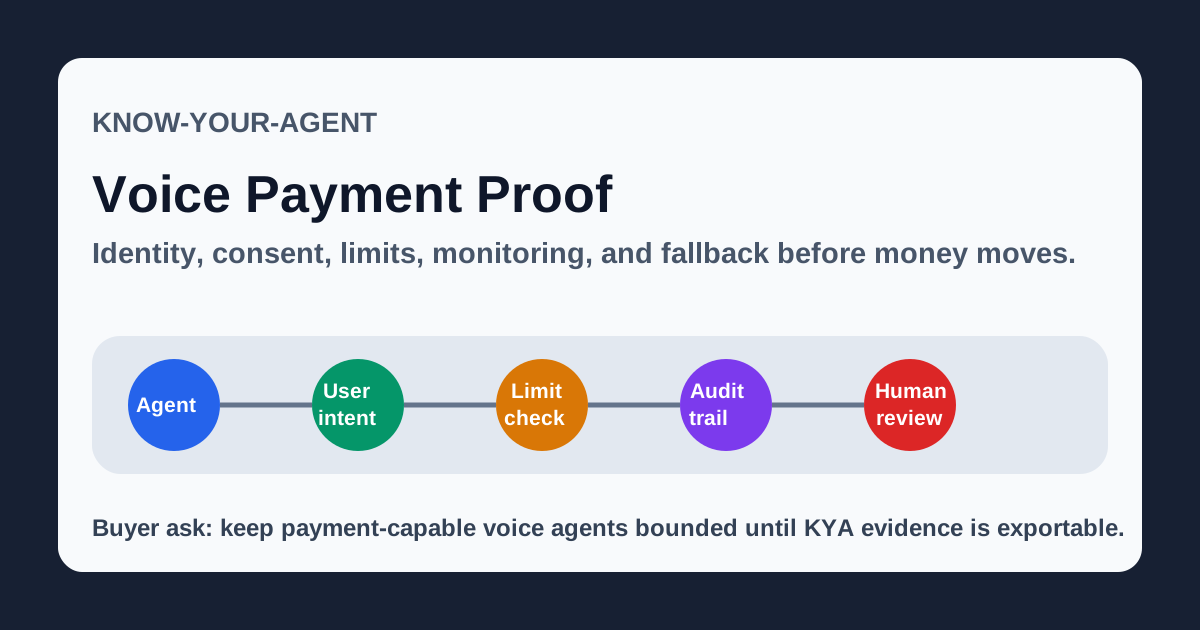
A voice-agent buyer should not approve a payment-capable voice workflow just because the speech experience feels natural. Ask for a Voice Payment Agent Proof Packet showing agent identity, operator traceability, user authentication, consent capture, transaction ceilings, monitoring signals, audit logs, fraud escalation, revocation and human fallback. If the vendor cannot show those controls on a sample call, the workflow should stay in information-only mode.
Voice Payment Agent Proof Packet
A buyer checklist for validating Know-Your-Agent identity, operator traceability, user consent, transaction limits, continuous monitoring, audit trails and human fallback in voice payment workflows.
| Proof item | Why it matters | Buyer ask |
|---|---|---|
| Agent identity | Payment networks and banks need to know which AI agent initiated or assisted a transaction, not only which user account was present. | Show the agent ID, version, deployment owner, allowed tasks and change history for every voice workflow that can affect money. |
| Operator traceability | KYA frameworks point toward linking agent activity to a validated operator, business or accountable party. | Document the merchant, platform, provider, wallet, bank and support owner responsible for each action in the call path. |
| Customer intent | A spoken phrase can be ambiguous, interrupted, translated or misheard, especially in multilingual voice banking. | Require explicit confirmation language, transcript snippets, consent markers and replayable evidence before payment execution. |
| Transaction limits | Setty's KYA remarks named transaction limits because autonomous agents can amplify a wrong decision quickly. | Define per-call, per-user, per-risk-tier and per-agent limits, then prove blocked and escalated cases in test calls. |
| Continuous monitoring | The payment-network KYA collaboration names continuous transaction monitoring as a core guardrail. | Show risk signals for unusual amounts, repeated attempts, changed beneficiaries, caller distress, prompt injection and failed confirmation. |
| Human fallback | High-stakes financial conversations need a bounded automation ceiling and a clear path to trained human review. | List the exact conditions that force human transfer, payment hold, callback verification, fraud-team review or account lock. |
What buyers should do next
- Separate information-only voice workflows from workflows that can initiate, approve, change, refund or schedule payments.
- Ask vendors for agent identity, operator traceability, authentication, consent, transaction-limit and audit-log examples.
- Run test calls for successful payment, blocked payment, ambiguous intent, multilingual consent, suspected fraud and human handoff.
- Keep payment-capable voice agents behind low limits until monitoring, escalation and revocation evidence is reviewed.
- Update procurement language so KYA-style controls are required before any voice agent can execute a financial action.
Turn this brief into a vendor packet
Make the vendor prove the workflow before the demo gets polished.
Use the RFP generator and call-test script to turn this news framework into concrete evidence requests, acceptance tests, and escalation rules for your own voice AI rollout.
Buyer FAQs
Is Know-Your-Agent already a binding rule for every voice payment agent?
No. The current signals are an interoperability collaboration from major payment organizations and public banking-industry remarks calling for KYA-style controls. Buyers should still use them as procurement requirements because they describe the proof payment workflows will need.
Why does this matter for voice agents specifically?
Voice agents compress identity, intent, language, accessibility, confirmation and transaction authority into a live call. That makes evidence of consent, limits, monitoring and fallback more important than in a simple text checkout.
What should stay out of scope at launch?
Keep high-value transfers, new beneficiaries, credential resets, disputed charges and risky refunds out of automated execution until human review and audit evidence are proven.
Sources
- Business Wire: September 9, 2026 announcement of Ant International, Mastercard and Visa collaboration on Know-Your-Agent interoperability for agentic commerce.
- Financial Express: September 10, 2026 report on SBI Chairman C.S. Setty calling for KYA identity, authentication, consent, limits, audit trails and voice-based conversational banking.
- Economic Times: September 10, 2026 coverage of Setty's Global Fintech Fest remarks on agentic AI risk, trust, audit trails and KYA.
- TechNode: Independent September 10, 2026 coverage of the Ant International, Visa and Mastercard KYA framework for AI payments.