
Direct answer: GPT-Live-1 becoming available through the API makes full-duplex voice a production-architecture decision. OpenAI says the model can listen and speak simultaneously, delegate deeper reasoning and tool calls to a backend model, support telephone deployments and price the front-end voice layer separately. Buyers should require a Live Voice Deployment Proof Packet before approval: connection path, delegation boundary, migration test, call controls, full-stack cost, observability, fallback and recovery evidence.
What happened
- OpenAI released GPT-Live-1 in the API on September 10, 2026 after first introducing the model in ChatGPT Voice in July.
- OpenAI says GPT-Live-1 handles listening and speaking in one model while delegating deeper reasoning and tool calls to a chosen backend model or agent harness.
- The release adds telephony support and lists the front-end voice layer at $0.05 per minute; backend reasoning, tools, infrastructure and carrier costs remain separate parts of the production total.
- OpenAI's telephony documentation describes two connection patterns: direct SIP and a server audio bridge over WebSocket, with the application still responsible for authorization, routing, call decisions and business logic.
- OpenAI's partner-integration guide lists LiveKit, Twilio, Telnyx and Daily/Pipecat paths and warns that an existing Realtime integration is not automatically compatible with GPT-Live.
- Independent implementation analysis from AgentRiot and Beagle highlighted the separate Live endpoint, migration work and the gap between headline voice-layer pricing and total call cost.
Why this is trending
- The July launch made full-duplex voice visible; API and telephony availability now let third-party products place it directly in business phone workflows.
- A Live voice layer that delegates reasoning and tools creates multiple owners for one call, so buyers need to know which component controls each action and failure.
- Direct SIP and server-bridge designs have different security, observability, media, latency and recovery responsibilities.
- Headline per-minute pricing can hide backend inference, tool, carrier, recording, storage and support costs that determine the real operating model.
- The migration warning matters because a polished Realtime demo is not proof that the same application can switch endpoints without retesting call control and failure behavior.
The Voice Agent Index take
A voice-agent buyer should use GPT-Live-1 API availability to move the conversation from model quality to production ownership. Ask the vendor to diagram the caller, carrier, SIP trunk or bridge, Live session, delegated model, tools, CRM, monitoring and human handoff. Then require evidence for who accepts and ends calls, who can create side effects, how latency and cost are measured, what happens when delegation stalls, and how the system falls back without losing the caller or repeating an action.
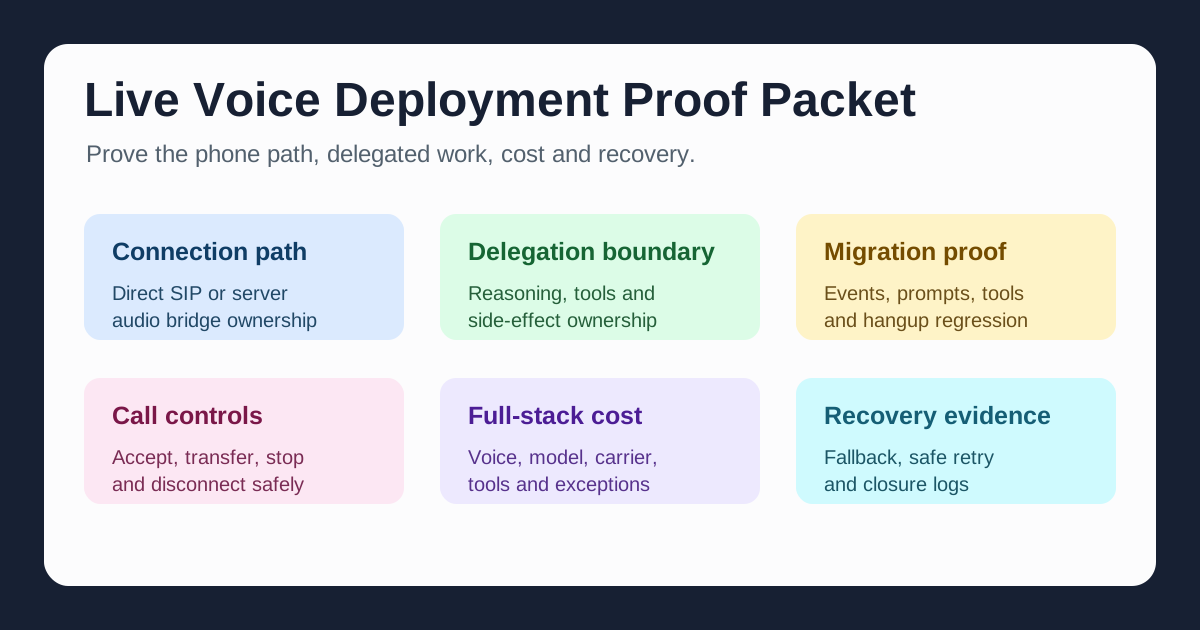
Live Voice Deployment Proof Packet
A voice-agent buyer checklist for validating the SIP or audio-bridge path, backend delegation, migration compatibility, call controls, full-stack cost, observability, fallback and recovery before launch.
| Proof item | Why it matters | Buyer ask |
|---|---|---|
| Connection path | Direct SIP and server audio bridges assign media, authentication, routing and lifecycle responsibilities differently. | Show the production call diagram, carrier path, encryption boundary, webhook owner, accepted codecs, regional route and failover path. |
| Delegation boundary | The live model may keep the conversation moving while another model or tool performs the consequential work. | Map which component reasons, calls tools, writes records, confirms completion and blocks duplicate or unauthorized side effects. |
| Migration compatibility | OpenAI says a Realtime integration is not automatically compatible with GPT-Live, so a model swap can become an application migration. | Run regression calls for events, prompts, interruptions, tool calls, transcripts, timeouts and hangups on the exact target endpoint. |
| Call controls | Accept, reject, transfer, interrupt and hang-up behavior determines whether the system can contain a bad or abandoned call. | Provide pass/fail evidence for inbound and outbound setup, caller authentication, transfer, cancellation, timeout and emergency stop. |
| Full-stack cost | The published voice-layer rate does not include every backend model, tool, carrier, storage, observability or support charge. | Price a representative minute and completed workflow with all model, carrier, tool, recording, storage and exception-handling costs. |
| Fallback and recovery | A stalled delegate, failed tool or broken media path can leave a caller waiting while an external action remains uncertain. | Demonstrate timeout language, safe retry, human transfer, state reconciliation, duplicate-action prevention and post-call recovery logs. |
What buyers should do next
- Choose direct SIP or a server audio bridge and document who owns media, authentication, routing, call lifecycle and business logic.
- Draw the delegation chain from spoken request through backend reasoning, tool execution, side effect, spoken confirmation and audit record.
- Run migration regression calls on the actual GPT-Live endpoint instead of treating an existing Realtime integration as compatible by default.
- Build a full-stack cost model that includes the voice layer, backend model, tools, carrier, recording, storage, monitoring and human exceptions.
- Rehearse delegate timeout, tool failure, carrier failure, duplicate action, human transfer and caller disconnect before production approval.
Turn this brief into a vendor packet
Make the vendor prove the workflow before the demo gets polished.
Use the RFP generator and call-test script to turn this news framework into concrete evidence requests, acceptance tests, and escalation rules for your own voice AI rollout.
Buyer FAQs
Is GPT-Live-1 the same as an existing Realtime API model?
No. OpenAI documents GPT-Live as its own session and integration path and says an existing Realtime integration is not automatically compatible. Buyers should require migration tests on the target endpoint.
Does the published per-minute price represent the full cost of a phone agent?
No. OpenAI describes $0.05 per minute as the front-end voice-layer price. Backend models, tool use, carrier service, recording, storage, monitoring and human exception handling can add cost.
What is the first production proof to request?
Ask for an end-to-end call trace that identifies the connection path, delegated model, tool owner, external side effect, spoken confirmation, cost record, monitoring signal, fallback and closure log.
Sources
- OpenAI GPT-Live-1 API release: September 10, 2026 primary release describing full-duplex interaction, backend delegation, telephony support, reported evaluations and voice-layer pricing.
- OpenAI telephony and SIP documentation: Official implementation guide covering direct SIP, server audio bridges, inbound and outbound sessions, authentication, routing and call controls.
- OpenAI GPT-Live partner integrations: Official integration guide listing LiveKit, Twilio, Telnyx and Daily/Pipecat paths and noting that Realtime integrations are not automatically GPT-Live compatible.
- AgentRiot: September 10, 2026 independent editorial analysis of the distinct Live endpoint, migration implications and separate voice-layer pricing.
- Beagle: September 21, 2026 independent implementation analysis of voice-layer pricing, backend delegation and total call economics.