
Direct answer: AP reported on October 1 that the Tokyo District Court recognized a right to one's voice in Japan in a landmark AI voice-clone case involving anime voice actor Kenjiro Tsuda and a TikTok account. The Japan Times, citing Reuters, reported that the court dismissed Tsuda's removal demand because the account had already been deleted, while still recognizing voice as a protected interest. For voice-agent buyers, the practical lesson is not that every global voice-rights question is settled. It is that cloned, actor-like, employee-like and branded voices need a proof packet covering source identity, permission scope, jurisdiction, commercial association, takedown and revocation evidence before production use.
What happened
- AP reported that the Tokyo District Court awarded legal protection to the human voice in what it described as a landmark AI clone case.
- The Japan Times reported that the court dismissed the removal demand because the account had already been deleted, while recognizing voice protection.
- The Guardian reported that the case involved claims that AI-generated videos imitated Tsuda's distinctive baritone voice.
- The ruling is a jurisdiction-specific legal development. It should be treated as a buyer diligence signal, not as a blanket rule for every country, voice or product.
Why this is trending
- Voice-agent buyers increasingly evaluate synthetic, cloned, actor-like, employee-like and brand-persona voices for calls, demos, ads and support workflows.
- The Tokyo ruling connects voice cloning to identity and publicity-rights evidence rather than only fraud detection or audio quality.
- This is distinct from the recent Meloni trademark filing story: the buyer asset focuses on production permission and stop-use proof after a court recognizes voice as a protected interest.
The Voice Agent Index take
Imagine an illustrative AI receptionist project that uses a warm, actor-like synthetic voice for inbound calls, then reuses the same voice in ads and product demos. A vendor's statement that the voice is available in a library is not enough. The buyer needs to know whose voice or persona is implicated, whether the use is licensed for the channel, which jurisdiction governs the claim, how takedown requests are handled, and how use stops if consent, policy or law changes. This framework is a procurement aid, not a legal opinion about the Tokyo case or any vendor's rights.
Publicity-Rights Voice Proof Packet
An original buyer packet for source voice identity, permission scope, jurisdiction status, platform response, commercial association risk and revocation logs.
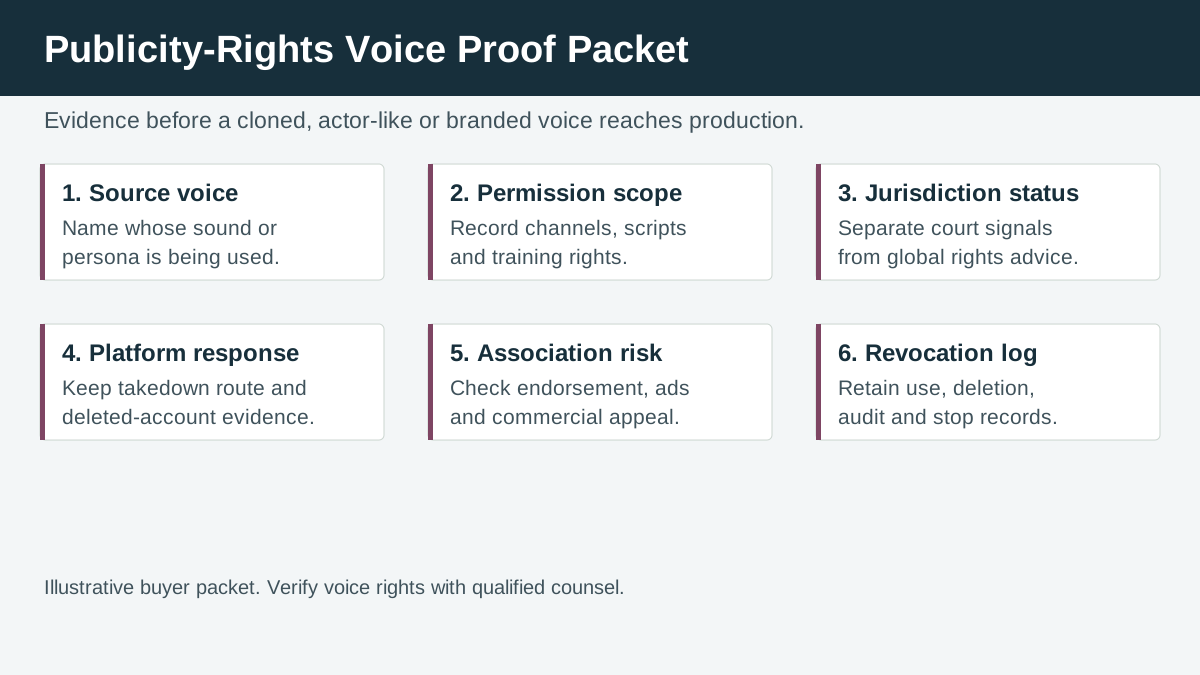
| Proof item | Why it matters | Buyer ask |
|---|---|---|
| Source voice | A voice can imply identity, endorsement, employment or artistic work even when the script is generic. | Name the source, actor, employee, stock voice, model family or consent record behind every production voice. |
| Permission scope | Permission for one recording, demo or language may not cover training, cloning, resale, ads, outbound calls or customer support. | Retain channel, geography, script, synthetic-use, training-use, resale and duration limits. |
| Jurisdiction status | Voice, publicity, copyright, consumer and privacy rules differ by market and can change after a ruling. | Record governing law assumptions, counsel review, excluded regions and unresolved legal questions. |
| Platform response | Takedown or deletion can moot one request without proving that all copies or derivatives are gone. | Keep report path, account status, removed URLs, retained evidence, mirror checks and escalation contacts. |
| Association risk | A voice that sounds like a known actor, worker or brand representative can create false endorsement or customer-trust risk. | Review commercial appeal, disclosure wording, call context, ad use, caller expectations and customer complaint handling. |
| Revocation log | Voice use can outlive a campaign, contract, employee role, consent period or product feature. | Define stop-use triggers, deletion evidence, access logs, generated-call inventory, vendor offboarding and audit retention. |
What buyers should do next
- Inventory every cloned, synthetic, actor-like, employee-like and brand-persona voice used in calls, demos, ads, support, training or QA.
- Tie each voice to source permission, allowed channels, geography, duration, training rights and revocation triggers.
- Ask vendors how they handle takedown, deleted-account evidence, copied audio, derivative models and customer complaints.
- Separate legal review by jurisdiction from audio-quality review and fraud-detection review.
- Keep stop-use, deletion, audit-log and customer-recovery evidence before expanding the voice into new workflows.
Turn this brief into a vendor packet
Make the vendor prove the workflow before the demo gets polished.
Use the RFP generator and call-test script to turn this news framework into concrete evidence requests, acceptance tests, and escalation rules for your own voice AI rollout.
Buyer FAQs
Did the Tokyo court order TikTok to remove the account?
The Japan Times reported that the removal demand was dismissed because the account had already been deleted. The buyer lesson is the court's recognition of voice protection, not a broad takedown order.
Does this ruling apply worldwide?
No. It is a Japanese court ruling. Voice-agent buyers should use it as a diligence signal and get qualified legal review for each market.
Can a vendor library voice be used without extra proof?
Not by assumption. Buyers should request source, permission scope, allowed uses, disclosure terms, revocation rights and audit logs for the actual production workflow.
Is this the same as the Meloni voice trademark filing?
No. The Meloni article concerned a pending EU trademark filing. This article concerns a Tokyo court's recognition of voice as a protected publicity-right interest in an AI clone dispute.
Sources
- Associated Press: October 1 reporting on the Tokyo District Court recognizing protection for the human voice in an AI clone case involving Kenjiro Tsuda.
- The Japan Times / Reuters: September 30 report that the court dismissed the removal demand while recognizing voice as a protected right.
- The Guardian: Independent coverage of the alleged AI imitation of Tsuda's distinctive voice and the court ruling.