

Direct answer: Google's Gemini 3.8 Live documentation describes a low-latency live model with native audio output, Extended Thinking and asynchronous function calling. That makes a practical buyer test: can the voice agent keep the caller informed while a lookup runs, without booking, charging, canceling or disclosing information before the tool result and confirmation are ready?
What happened
- Google describes Gemini 3.8 Live as a native-audio model for real-time voice applications.
- The model documentation highlights Extended Thinking and asynchronous function calling, meaning an application can keep interacting while a function call is in progress.
- Independent developer coverage has framed the release as a meaningful voice-agent capability upgrade.
- The launch does not by itself prove any deployment is production-safe across telephony, tools, compliance and human handoff.
Why this is trending
- Voice-agent competition has moved from sounding natural to managing background work while the caller is still on the line.
- Async tool calls can reduce silence, but they also create a new failure mode: the agent may speak confidently before the authoritative result is available.
- This differs from the Microsoft streaming-speech story. The gate here is background tool timing and business-action authority, not provisional transcription.
The Voice Agent Index take
Consider an illustrative scheduling call. The agent can say it is checking availability while a calendar lookup runs, but it should not confirm the appointment until the tool returns, conflicts are handled, and the caller accepts the final slot. The same boundary applies to refunds, payments, identity checks and protected account details.
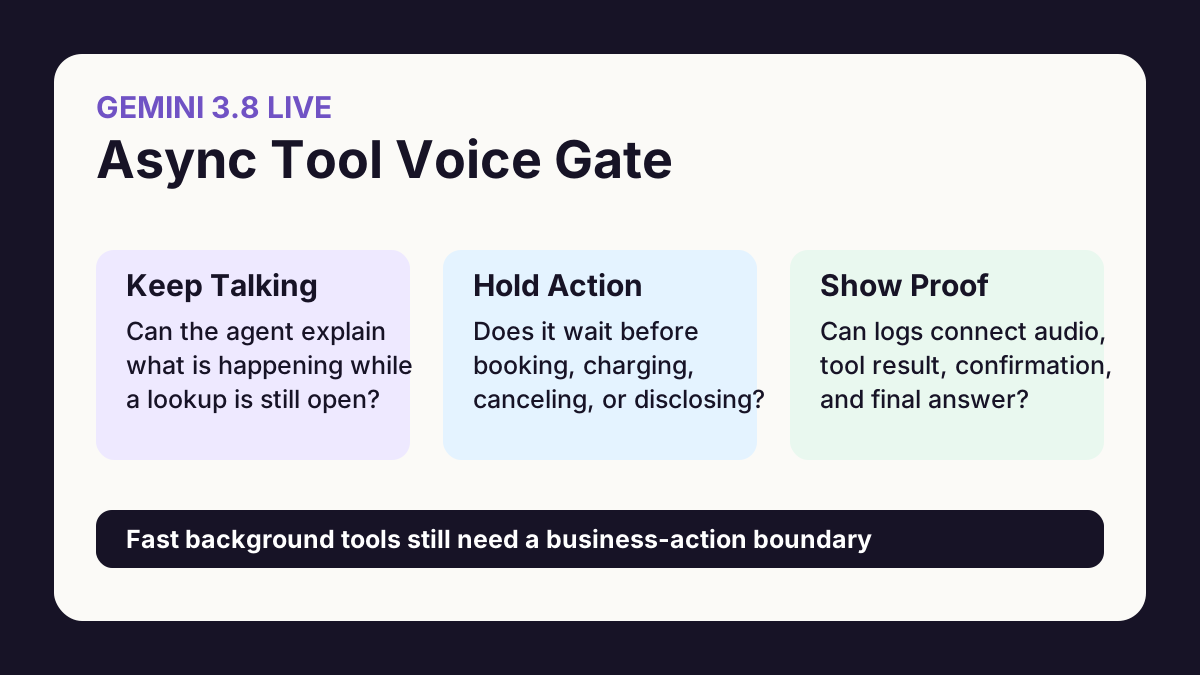
Async Tool Voice Agent Gate
An original buyer test for background tool calls, spoken filler, commitment boundaries, confirmation, rollback and call-level evidence.
| Proof item | Why it matters | Buyer ask |
|---|---|---|
| Background tool state | The caller hears speech while the authoritative result may still be pending. | Show logs for tool requested, pending, returned, failed and timed out states. |
| Spoken filler policy | Helpful narration can become a false promise if it implies a result is known. | Approve exact language for checking, waiting, retrying and escalating. |
| Commit boundary | A tool result can change the next valid action. | Separate read-only lookup from booking, payment, cancellation and disclosure actions. |
| Timeout and failure route | The agent must recover when a tool is slow, unavailable or contradictory. | Test timeout messaging, callback offer, human transfer and retry limits. |
| Confirmation and rollback | A fast voice flow can still make the wrong change. | Require caller confirmation and idempotent rollback for record-changing actions. |
| Call-level evidence | Buyers need proof after disputes, not only demo success. | Connect audio, transcript, tool result, confirmation and final action in one reviewable packet. |
What buyers should do next
- Write test calls where lookup tools return fast, slow, wrong, empty and conflicting results.
- Approve what the agent may say while a tool is still running.
- Label each action as lookup, reversible draft, confirmation-required, human-only or prohibited.
- Measure end-to-end timing through the actual telephony, model, tool and logging path.
- Review failed calls and disputes before expanding to more workflows.
Turn this brief into a vendor packet
Make the vendor prove the workflow before the demo gets polished.
Use the RFP generator and call-test script to turn this news framework into concrete evidence requests, acceptance tests, and escalation rules for your own voice AI rollout.
Buyer FAQs
What is the buyer issue with async function calling?
The agent can keep talking while a tool runs. That helps reduce dead air, but buyers need proof that the agent waits for the tool result and confirmation before taking business-changing action.
Is this the same as streaming transcription?
No. Streaming transcription concerns provisional words from the caller. Async tool calling concerns background business actions, lookups and tool results while the conversation continues.
Does Gemini 3.8 Live make a voice agent production-ready by itself?
No. Buyers still need telephony integration, tool boundaries, logs, monitoring, human handoff, privacy review and workflow-specific acceptance testing.
What should buyers test first?
Test slow tool returns, tool failures, corrections, irreversible actions, human transfer and a dispute review that connects audio, transcript, tool result and final action.
Sources
- Google Gemini Live API documentation: Primary technical source for Gemini Live model behavior, native audio, tools and realtime API context.
- Google Gemini model docs: Primary model reference for Gemini model capabilities and configuration context.
- DataCamp launch coverage: Independent developer coverage of Gemini 3.8 Live, including Extended Thinking and asynchronous function-calling framing.